Sunday, 16 April 2017
Monday, 10 April 2017
Thursday, 6 April 2017
A new round of Ulysses has just begun.
Check this site to keep track of how far the group has read each week. The last reading
stopped at “you dreadful bard” (1.134).
The numbers in parentheses refer to the Hans
Gabler edition. The first number indicates the chapter, the second the line on
the page.
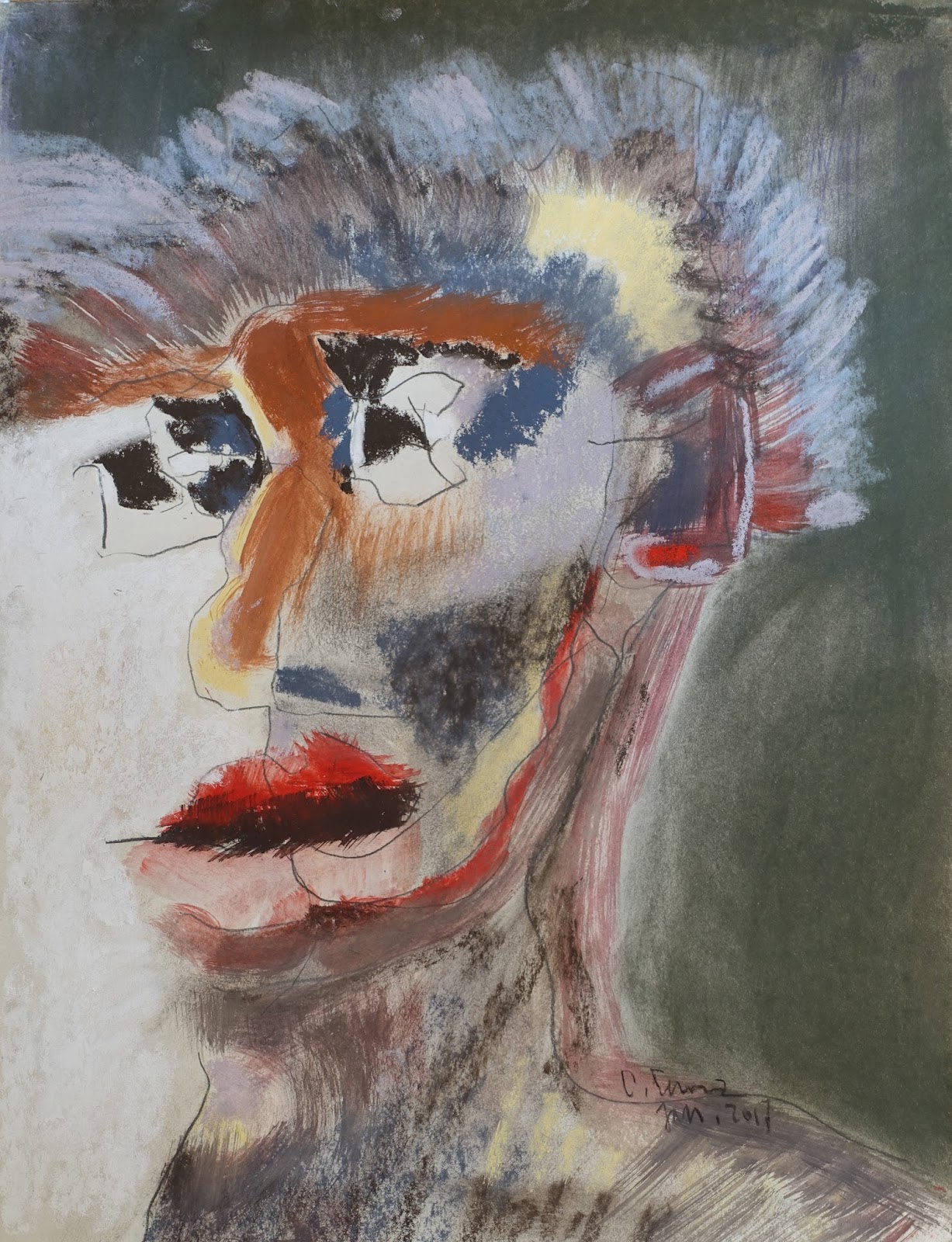
Catherine Meyer (local artist and
long-standing member of the reading groups) has, sends a painting to illustrate the passage just read. We have the artist's permission to reproduce her works
in this blog.
| Catherine Meyer © Zürich, 2017 |
Thursday, 6 April 2017
New reading group
A new round of Ulysses readings is starting on
Thursday, April 6, 2017
Everybody is welcome to join.
To download flyer click link below:
Tuesday, 4 April 2017
Thursday, 30 March 2017
The group reached the end of Ulysses last week. A new round of the book is beginning on Thursday, 6 April 2017. Everyone is welcome – first-time readers and recidivists.
To conclude this round, Catherine Meyer, local artist and long-standing member of the reading groups, sends a last painting with these words:
The idea for my picture was to capture the various feelings, sentiments and instances of “yes” coming from Molly. The blue background reminds her of “O and the sea the sea” (18.1598), probably remembering Gibraltar as well as Howth and echoing Buck Mulligan’s exclamation “Thalatta! Thalatta!” earlier in the book (1.80).
As the episode “Penelope” has both, a sense of chaos and a strictly composed structure, I tried to do the same with the center of my painting. It looks chaotic but I composed it very carefully, going through many stages.
The famous closing words “yes I will Yes” frame the picture. To stress the optimism in these words about the unknown future of the Blooms I used vivid and lively colours.
| Catherine Meyer © Zürich 2017 |
Monday, 27 March 2017
Thursday, 23 March 2017
The group is about to finish the book. Around two pages from the end of episode 18, the reading stopped at: “That ought to satisfy him” (18.1513)
Catherine Meyer, who has been illustrating each week with paintings and drawings inspired from the readings, sends another contribution with the following words.
It is very, very late at night and Molly’s mind is still circling around love:
“all the amount of pleasure they get off a womans body“ (18.1380);
and Bloom embracing her only sometimes, whereas “of course a woman wants to be embraced 20 times a day almost to make her look young” (18.1408);
“I suppose its all the troubles we have makes us so snappy” (18.1459);
and “Im not like that” (18.1460), referring to her previous thoughts that “we are a dreadful lot of bitches” (18.1459)
– which I took to depict in watercolours and gouache.
| Catherine Meyer © Zürich 2017 |
Monday, 20 March 2017
Thursday, 16 March 2017
The last reading stopped at: “imagine paying 5/- in the preserved seats for that to see him” (18.1290)
Catherine Meyer sends a painting with the following words:
In my pile of older, sometimes abandoned drafts, I found a watercolour sketch of one of my models which I could use to depict a court-scene from the 1933 trial, where Judge John M. Woolsey ruled that Joyce’s novel Ulysses was not obscene and could lawfully be imported into the United States. His word, which became famous, were:
“I am quite aware that owing to some of its scenes Ulysses is a rather strong draught to ask some sensitive, though normal, person to take. But my considered opinion, after long reflection, is that whilst in many places the effect of Ulysses on the reader undoubtedly is somewhat emetic, nowhere does it tend to be an aphrodisiac.” (Richard Ellmann, James Joyce, p. 667)
In my picture I turned “the somewhat emetic” into “tends to be aphrodisiac”.
| Catherine Meyer © Zürich 2017 |
Monday, 13 March 2017
Thursday, 7 March 2017
The last reading reached: “a great touchmenot too in her own way” (13.1037)
Catherine Meyer sends the following report and accompanying picture:
Molly's character does not seem be of everybody's liking. Her inner monologue circles around sex quite often and her attention keeps going back to that dominant topic. One reader observed that Homer's Penelope is the exact opposite and that she is faithful, while Molly is always thinking about her many amorous adventures, real or imaginary ones.
My Rock of Gibraltar is painted in various bright colours to echo Molly’s inner monologue.
| Catherine Meyer © Zürich 2017 |
Monday, 6 March 2017
Thursday, 2 March 2017
The reading stopped at: “Id like a new fellow every year” (18.782)
Catherine Meyer, local artist and long-standing member of the reading groups at the Joyce Foundation, sends a drawing to illustrate a favourite passage. She writes:
The “nobleman named Don Miguel de la Flora” (18.773), who came up at the end of the reading, sparked the idea of dedicating a bouquet of flowers to “our” protagonist, Bloom. Bloom, flower, Virag, Flora – all of these words have accompanied us throughout the novel. “With muchibus thankibus” (7.780) to Bloom, who has entertained us every Thursday afternoon for more than two years.
| Catherine Meyer © Zürich 2017 |
Monday, 27 February 2017
Thursday, 23 February 2017
The reading stopped at: “when was that 93” (18.555)
Catherine Meyer sends a painting to illustrate a passage from the last reading, which she describes as tricky and not all that easy to do in a group due to its intimacy and outspokenness (it mentions titties and thighs, a man's “two bags”, bodily actions etc.). For her picture she chose a description of Molly and Poldy discussing what kind of hat suits her, how much it costs and the advice he gives her while trying to buy one:
“if I went by his advices every blessed hat I put on does that suit me yes take that thats alright the one like a weddingcake standing up miles off my head he said suited me or the dishcover one coming down on my backside on pins and
needles” (18.520)
needles” (18.520)
The title of the watercolour is “Molly and the dishcover wedding cake hat”.
| Molly and the dishcover wedding cake hat by Catherine Meyer © Zürich 2017 |
Monday, 20 February 2017
Thursday, 16 February 2017
The last reading stopped at: “alone in the carriage that day going to Howth” (18.371)
Catherine Meyer sends a painting inspired by the passage just read and adds:
While reading through these pages, the words “he was shaking like a jelly all over” (18.315) caught my eye and the description of wobbly, pink jelly looking at Molly’s orange petticoat animated my imagination. I wanted to paint a Molly who enjoys being renowned and highly coveted. She is voluptuous, lifting her orange petticoat and aware of how her sex appeal is making Bloom shake. She is also recalling how he once wrote her “that letter with all those words in it” (18.318). We don’t know them, but we can imagine them.
| Catherine Meyer © Zürich 2017 |
Monday, 13 February 2017
Thursday, 9 February 2017
The Thursday group stopped at: “cutting her teeth too” (18.159)
Catherine Meyer sends another great painting to illustrate last week's reading, accompanied by the following comment:
Once again and now from Molly’s perspective we read about oysters and their supposed aphrodisiac effect: “he must have eaten oysters I think a few dozen” (18.149).
Having read about oysters in previous chapters, I found notes about them and sketches in my notebook and of course a reference to Fritz’s joke about a man asking, “What’s all this mystic about oysters? I had a dozen and only nine of them worked”.
In my painting two ostyers are open and one is closed – as the joke has it, not all of them work. The open ones stand for “being able” (to eat etc.), the closed ones stand for “not being able” (to eat, being inedible etc.)
I enjoyed painting the oysters and the oyster eyes. It is, according to my previous notes, a word that appears many times in the book and it has now received a tribute from my side.
| Catherine Meyer © Zürich 2017 |
Monday, 6 February 2017
Tuesday, 31 January 2017
Thursday, 26 January 2017
The reading stopped a few pages from the end of the chapter at: “the apathy of the stars” (17.2226).
Catherine has captured some of the reading in a painting. She writes:
I tried to feel how words like envy, jealousy, abnegation and equanimity would reflect colours combined with a portrait of a nobody. This is how I see these different feelings worked into a portrait.
| Catherine Meyer © 2017 |
Monday, 23 January 2017
Thursday, 19 January 2017
The group read down to: “the woolen mattress (biscuit section)” (17.2041)
Catherine Meyer takes the last lines of the reading as a lead for a watercolour: the idea that, when an iron is unavailable, one can still press trousers by folding them neatly and placing them lengthwise between two spring mattress. She writes:
My painting shows Bloom who enjoys the merits of an occupied bed, the female warmth and the trousers, which will be ironed in the morning.
| Catherine Meyer © Zürich 2017 |
Tuesday, 17 January 2017
Thursday, 12 January 2017
The reading stopped soon after the description of the Wonderworker at, “a lady by origin” (17.1853).
The Wonderworker is described in more detail on http://www.jjon.org: It was a “small spade-shaped” device designed “for the insertion in the rectum, intended originally as a cure for hemorrhoids but later accepted for its talismanic properties in the treatment of all human ills” (http://www.jjon.org/joyce-s-environs/wonderworker, from Norman Lewis's autobiographyJackdaw Cake).
Monday, 9 January 2017
Thursday, 5 January 2017
The reading resumed again in the new year with some of “Ithaca's” long lists. The group was lively, the reading room packed and they progressed to: “all recalcitrant violators of domestic connubiality” (17.1633).
Catherine Meyer, Zurich artist and long-standing member of the reading groups, sends these visual contributions for the blog and writes:
For this painting I just had to choose a long list, describing either books or the interior or the exterior of Bloom’s imagined house. The result was a picture devoid of emotions but containing all the details mentioned in the list. Too boring. I made two other paintings with the same topic. I wasn’t successful and I didn’t like them.
So instead of going through the list again I said to myself, I have my own inspiration, and I made a watercolour depicting Bloom’s leisure activities.
| Catherine Meyer © Zürich 2017 |
| Catherine Meyer © Zürich 2017 |
| Catherine Meyer © Zürich 2017 |
Monday, 26 December 2016
Thursday, 22 December 2016
The next reading will be on Thursday, 5 January 2017, resuming the “Ithaca” episode with the long list of books following the command “Catalogue these books” (17.1361).
Catherine Meyer sends a painting to render one of the scenes encountered during the last reading. She writes:
For the first time I chose the topic of reunion (when Odysseus and Telemachos first meet again after 20 years) and of separation (of Bloom and Stephen) and painted the scene as an inverse relationship. I tried to capture a feeling of both joy and sadness and painted the white spot with a drive towards the interior and the green and orange surface with strokes leading horizontally out of the picture's margin.
Wednesday, 21 December 2016
Thursday, 15 December 2016
The reading stopped at: “an insistent vesicle pressure” (17.1198)
Catherine sends a painting and a comments:
Like children who are full of anticipation for Christmas, Fritz couldn’t wait to tell us that we were getting to the funniest part of the book: the peeing passage. He really was enthralled and told us all kinds of stories, such as how men stand and pee, how they look at each other while doing so, and how wonderful the many s‘s in the text make the sound audible. We laughed superbly and the women were more than impressed with all those different peeing-descriptions.
For this topic I painted a very romantic peeing-scene: in Bloom's garden, under the dark sky, with stars and the moon.
Looking at the moon, which is only a scythe, Bloom maybe thinks of his relationship with Molly: her splendour when visible, her attraction when invisible.
![]() |
| Catherine Meyer © Zurich 2016 |
Tuesday, 13 December 2016
Thursday, 8 December 2016
The reading has reached: “advanced by the latter to the former” (17.959)
Catherine Meyer sends a visual rendering with these words:
My picture depictes the following:
Bloom and Stephen in one person
God the Father as Bloom and Stephen as Jesus Christ
Past and future (Bloom looking back and Stephen looking to the right into the future)
Father and Son
Bloom with his mustache and hat, and of rather short height
Stephen tall, white skinned with winedark hair
Bloom down-to-earth and realistic
Stephen having his head in the clouds beeing intellectually out of touch with the real world
Sometimes I think that Stephen is not a real person but only imagined by Bloom.
Monday, 5 December 2016
Thursday, 1 December 2016
The reading stopped at, “a rabbinical philosopher, name uncertain” (17.718).
Catherine Meyer sends an illustration for this blog-entry. She writes that for her (despite the complicated and somewhat confusing biblical and political references to ancient times and contemporary Dublin) “the most painterly scene was A Pisgah Sight of Palestine or The Parable of the Plums” (17.640). About her painting she says:
In Bloom’s kitchen Stephen and Bloom are sitting apart from each other, separated by the plums that are lying on top of each other forming a pyramid. In the background are Mount Pisgah and Nelson's Pilar.
| Catherine Meyer © Zürich 2016 |
Monday, 28 November 2016
Thursday, 24 November 2016
The reading stopped after an account of ten year old Stephen inviting Bloom to dinner on a rainy Sunday in January 1892, which Bloom “very gratefully, with grateful appreciation, with sincere appreciative gratitude, in appreciatively grateful sincerity of regret” in the end “declined” (17.476).
I chose four ladders with their rungs and the space between them as a symbol for question and answer and, at the same time, they stand for Bloom‘s bloomy declining of the invitation (still the same ladder, but the space in between varies). We're in Bloom’s picturesque kitchen with all the stuff on the three shelves, the eye-catcher on the coralpink tissue paper half disrobed (slightly erotic) and the “double falciform ejection of water vapour from under the kettlelid” (17.273). The observer under the shelf is me.
| Catherine Meyer © 2016 Zürich |
Monday, 21 November 2016
Thursday, 17 November 2016
The group has started episode 17, also referred to as “Ithaca”, and stopped at: “a wooden revolving roller” (17.235)
Catherine Meyer, although wary of the episode's foregrounded form – questions-and-answers, geometry, maths – was still curious to dwell on the opening lines, “What parallel courses did Bloom and Stephen follow returning?”, to try a response in image. She writes:
For the start Joyce chose a complicated term in the sense of maths, art and daily life. In mathematics, lines are parallel if they are always at the same distance from each other. They never meet. In art, you have a vanishing point where all parallel lines meet. So, the further away a track is the smaller it appears. And in daily life, “parallel” can also mean: more than one event happening at the same time.
My painting shows parallel lines depicting water in its universality, the kitchen in Bloom's home and, figuratively, the question-and-answer form of the catechism in the blue water's light and dark colours. Technique: watercolour.
| Catherine Meyer © Zürich 2016 |
Tuesday, 15 November 2016
Thursday, 10 November 2016
The group has reached the end of episode 16 (“Eumaeus”) and will start episode 17 (“Ithaca”) this week.
Catherine Meyer, local artist and long-standing member of the reading groups, sends her rendering of the last reading. The passage that held her attention and tickled her creative energy most this time was:
“Und alle Schiffe brücken” (16.1884). She explains:
Fritz said he thinks this could have something to do with the German term “Schiffbruch”, and what came to my mind immediately was the disastrous shipwreck of the Medusa (1816) and Géricault's large and well-known rendering of it: He painted the ca. 5 x 7 m Raft of the Medusa in 1818 and it became a great scandal. It is hanging in the Louvre. But even more important is the fact that Friedrich von Flotow wrote an opera called Le Naufrage de la Méduse (1839 Paris) (Ge, Die Matrosen, 1845 Hamburg).
“Schiffbruch” in German is also used as an image to express personal failure in the phrase “Schiffbruch erleiden” (similar to the image of the shipwreck in English). Also “in die Brüche gehen“ (going to pieces) is a negative statement and, at least in sound, is close to “Brücken“ (in meaning, though, it would express the opposite of “to bridge”). Anyway, something goes wrong here, this much is probably agreed.
To underline this statement Joyce has Stephen say that he does not understand why they put the chairs upside down on the tables. In Züri- and Berndeutsch we use the expression “usestuele“ meaning “jemanden vor die Tür setzten, kündigen, feuern etc. auch oft benützt für den Rauswurf in einer Beziehung” (to kick someone out, to fire them, also with regard to a relationship).
Granted, this may all be a little far-fetched but after all, Joyce forces you to think around the corner (to translate directly from the German idiom for “to think outside the box”).
My small-sized picture shows the chairs, the “Schiffbruch” and the two men walking home to 7 Eccles street.
| Catherine Meyer © Zürich 2016 |
Monday, 7 November 2016
Thursday, 3 November 2016
The last reading stopped at: “The Arabian Nights Entertainment was my favourite and Red as a Rose is She.” (16.1681)
The reading was another “exciting and enthralling one”, says Catherine Meyer, who sends a rendering of it in one of her own equally engaging paintings. She writes:
Earlier in the day Bloom had seen those Grecian statues, perfectly developed as works of art, and wondered whether they also had an anus or not. Thinking back to those perfect statues and looking at an old photograph of his singing wife which he has been showing stephen, he then remembers “the morning littered bed etcetera and the book about Ruby with met him pike hoses (sic) in it which must have fell down sufficiently appropriately beside the domestic chamberpot with apologies to Lindley Murray” (16.1472).
I chose these thoughts for a visual interpretation. It is an echo to the third chapter where Stephen thinks about the “ineluctable modality of the visible” (3.1).
Audible and written words = nacheinander
Visible and paintings = nebeneinander
So, you can see Bloom’s various thoughts in one picture. I had a lot fun with this subject and have thus painted it in lively colours.
| Catherine Meyer © Zürich 2016 |
Monday, 31 October 2016
Thursday, 27 October 2016
The reading stopped at Bloom's utterance:
— Was she? … it was as she lived there. So, Spain. (16.1420)
Catherine Meyer sends a contribution for this blog. She comments:
Last Thursday we read a long passage about the murder of Parnell, the court-case and all the dirty laundry washed in public about Kitty O’Shea and Parnell's affair. We didn’t read many pages but there were many attenders, some of whom had to sit beyond the row of tables, so that I had an inviting view of them. Here is a sketch.
| Catherine Meyer © Zürich 2016 |
Tuesday, 25 October 2016
Thursday, 20 October 2016
The reading stopped at: “Sheer force of natural
genius, that. With brains, sir” (16.1215)
Catherine Meyer's post-reading paintings reflect several themes encountered there, including the “untasteable
apology for a cup of coffee” (16.1141). Thank you, Catherine, for letting us show your work!
1
| Catherine Meyer © Zürich 2016 |
2
| Catherine Meyer © Zürich 2016 |
Saturday, 15 October 2016
Friday, 7 October 2016
Thursday, 6 October 2016
The reading stopped at: “would confer a lasting boon on everybody concerned” (16.747)
If you look at the picture you can see a nude that provides the “light” with her pale skin and is looking through the window wearing a black hat . The sailor, Stephen and Bloom are sitting at the table. The sailor is showing his tattoo of Antonio, who is either cursing his mate or laughing at a yarn, depending on whether the sailor pulls his skin or not.
When I sat back to look at the finished painting I was pleased to see that what is given centre stage shows a clear narration of the situation, while the background consists of a depiction of hidden hints.
Subscribe to:
Posts (Atom)